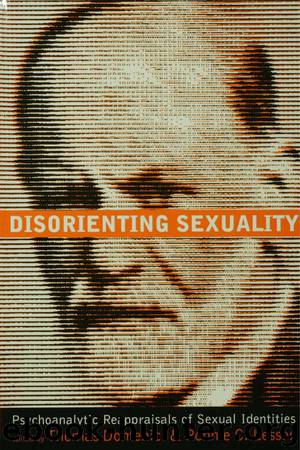
Disorienting Sexuality: Psychoanalytic Reappraisals of Sexual Identities by Thomas Domenici and Ronnie C. Lesser
Author:Thomas Domenici and Ronnie C. Lesser
Language: eng
Format: azw3
Publisher: Taylor and Francis
Published: 2016-03-22T16:00:00+00:00
Conclusion: Between Instinct and Object
To put my argument at its strongest: We should sever the tie between psychoanalysis and the Discourse of Nature. We should forgo not only the classical grounding of sexuality in the requirements of evolutionary survival, but also the relatively recent relational idea that what’s natural is not sex but attachment. As Thomas Domenici puts it (in this volume), where classical theory sees affective and interpersonal needs as “an overlay upon a more basic template of sexuality and aggression,” object-relations theory reverses the matter, making sexuality the secondary precipitate of a desire for connection and intimacy.
If Freud missed something about relatedness, this naturalizing of attachment overlooks something about desire. “Excitement,” Adam Phillips observes, “tends to turn up in object-relations theory as a defense against something reputedly more valuable.… The implication … is that freedom is freedom from bodily excitement. As though in states of desire the self was, as it were, complying with the tyranny of the body” (1988, 71). Object relations theory, by subordinating the erotic to relatedness, partakes of a certain puritanism that may be discerned in, for example, Winnicott’s “distrust of, or dismay about, the nature of instinctual life” (Phillips 1988, 71). That psychoanalytic puritanism (an oxymoron, no?) is, itself, regulatory practice hardly needs demonstrating, but in any case will have to be argued elsewhere.
What I am suggesting and initiating is a deconstruction of psychoanalysis’s use of Biology, its participation in the Discourse of Nature which is the foundation for its regulatory power. Psychoanalysis and the Discourse of Nature are historically mutually constitutive: the idea of Nature informs the theory of human nature which, in that vicious rhetorical circle, recreates a notion of givenness. Yet, as Ross (1994, 250) argues, nature lacks a common meaning, even as it seems to be common sense; everyone, from conservation biologists to sociobiologists, from economists and politicians to poets, means something different by it.
For psychoanalytic purposes, the idea of the Natural is not so much wrong as incoherent. It’s certainly true that, given that the human species reproduces itself biologically through the union of spermatozoon and ovum, a penis and vagina that, you might say, want each other are critical for the propagation of species; as is, therefore, a psyche appropriately coded for a set of heterosexualizing institutions, like, marriage, parenting, and the family. However, this reproduction doesn’t just happen; to borrow Beauvoir’s pronouncement on women, heterosexuality is made, not born.
To take a dialectical view: That which potentiates reproductive heterosexuality also undoes it. Desire must flower for heterosexual—and procreative—activity to occur. If it does, however, then so do impulses and tendencies —polymorphous perversity—that may contradict procreative sex and the normative structures housing it. As Freud’s thesis on the direct relation between neurosis and sexual inhibition suggests (1905), many psychological and cultural events must take place if one is to be turned on by people of only one sex, either one’s own or the opposite. Being excited by the Other doesn’t just happen. It requires a context, one potentiated by the one- and two-person work/practice/activity of relatedness.
Download
This site does not store any files on its server. We only index and link to content provided by other sites. Please contact the content providers to delete copyright contents if any and email us, we'll remove relevant links or contents immediately.
Should I Stay or Should I Go? by Ramani Durvasula(7733)
Why We Sleep: Unlocking the Power of Sleep and Dreams by Matthew Walker(6797)
Fear by Osho(4805)
Flow by Mihaly Csikszentmihalyi(4794)
Rising Strong by Brene Brown(4525)
Why We Sleep by Matthew Walker(4498)
The Hacking of the American Mind by Robert H. Lustig(4438)
How to Change Your Mind by Michael Pollan(4412)
Too Much and Not the Mood by Durga Chew-Bose(4406)
Lost Connections by Johann Hari(4265)
He's Just Not That Into You by Greg Behrendt & Liz Tuccillo(3931)
Evolve Your Brain by Joe Dispenza(3720)
The Courage to Be Disliked by Ichiro Kishimi & Fumitake Koga(3565)
Crazy Is My Superpower by A.J. Mendez Brooks(3466)
In Cold Blood by Truman Capote(3434)
Resisting Happiness by Matthew Kelly(3393)
What If This Were Enough? by Heather Havrilesky(3355)
The Book of Human Emotions by Tiffany Watt Smith(3353)
Descartes' Error by Antonio Damasio(3349)
